A Polyvagal Approach to Healing Trauma with the Safe & Sound Protocol (SSP)
By Laura Reagan, LCSW-C
Watch the Therapy Chat interview with Dr. Stephen Porges and Karen Onderko about SSP here.
Something Feels Off…
Have you ever felt like your body has a mind of its own, reacting to situations even when your logical brain tells you nothing is wrong? Or maybe you’ve noticed that your body seems to tense up at times, even when you’re not consciously aware of a reason why it’d do that.
For some of us, it feels hard to be close with others – we don’t really trust people – for reasons we can’t put our fingers on. We might feel lonely, or we might feel that it’s wise to keep others away, due to past negative experiences of abandonment and betrayal. Many of us struggle with expressing our needs and communicating our boundaries in relationships of all kinds – romantic relationships, parenting, at work, with our friends, and even with strangers.
Avoiding Discomfort in Groups
I can relate to this! I used to keep people at arms length. It was the most obvious when I was in a group setting. In grad school we had to do group projects – for those who don’t know, graduate school in Social Work means group projects in every class. Every single class included a group project. I guess that’s why they call it “Social” Work!
Many of us hate group projects, because of the group dynamics that always show up. It’s kind of funny, we tend to fall into family roles in groups – everywhere we go, including in professional settings. I talked about this a couple years ago on the Unsaid @ Work podcast with Catherine Stagg-Macey. Once I was done with group projects I basically avoided group settings as much as possible.
Not so easily, though, as my work involves attending frequent trainings; my personal healing journey has included many retreats and other group experiences; and as a human, I’m in groups all the time – family, community, work, etc.
Group Socialization: What Happened for Me
Here’s how it usually went:
- First I’d notice the thought “none of these people are anything like me.” I couldn’t relate to the other people in the group. It was unconscious at first but as I began to connect more with my body, I realized I was having the thought that I didn’t fit in. I would make meaning out of that – usually “they don’t get me, (because I don’t belong)” – I was operating in group settings as if I was always the outsider.
- Still, another part of me was determined to make myself more comfortable, to soothe my feelings of anxiety and rejection due to being an outsider. So that part would make sure I found one person in the group to connect with, and that would be “my person”. Then I’d feel comfortable to be myself.
- The person I’d select was usually someone else who came across as very self-reliant, like me. We’d ultimately become friends, and another part of me would wish we could connect on a deeper level, but the other person usually wasn’t too open to that. I chose them because they were kind of closed off, like me, but then another part of me wanted them to be more open. You can see how that would work out! I found myself always longing for more from the people I chose to surround myself with.
A Different Approach
Now, I operate differently in group settings. I naturally feel curious about everyone there. I tend to look at everyone in the group through a compassionate lens – whether it be the person who has a lot to say, the person who is feeling left out, the person who is responding defensively, the person who doesn’t want to say anything, the person who looks like they’d rather not be there, etc – I’m understanding that they have reasons for their way of being.
What’s even more different for me, though, is that I don’t see anyone in the group as being very different from me. I feel like we all belong and I feel happy to have the opportunity to be with a diverse group of people. It doesn’t feel unsafe, anxiety-provoking, or scary to be around people whose perspectives are different from my own. I feel like I have the right to be there, just like they do. I feel like if there’s a conflict, I can speak my truth, and I’m comfortable expressing my boundaries. This shift is true whether I’m in a group therapeutic experience, a training, a family setting, at work, or in a new place.
Looking Beyond Group Settings
This pattern was more obvious when I was in groups, but in a lot of ways I kept people at arms length in all of my relationships, just like I discussed with Catherine on the podcast I linked above. I didn’t really trust anyone. I really didn’t trust myself. This was because my system had more experiences of being let down by others when the going got tough than experiences of being taken care of and helped when I needed it. So it protected me by focusing on being self reliant and not needing help.
Just one major problem with that! We all need help at times. In fact, we are wired for connection as a biological imperative. There’s no getting around it, we’re social animals and we are meant to be interconnected. I tried to avoid vulnerability to keep myself feeling safe, and the result was I felt like I was on the outside – until something changed for me. I started the long, slow process of healing from the attachment wounds which were holding me back.
How Things Changed
You might be wondering what changed for me. How did I shift my relational patterns to become more comfortable in my own skin? Well, I’ve been on a healing journey for decades, including nearly 9 years with my current therapist. And there are many things that have made a difference in the way I feel and behave in relationship to myself and others. In this blog post I want to highlight the one that has made the most drastic shift, the quickest and most sustainable, for me.
There are some new sound healing technologies based in Polyvagal Theory that can help our nervous systems feel safe being more relational. They can help us reconnect to who we have always been, without the trauma and attachment reactions we developed to help us adapt to our environments keeping us from allowing connection. One of these is a psychoacoustic healing program called the Safe and Sound Protocol which I’ve experienced, and have started using with my clients.
If you’re searching for ways to understand and heal from past experiences that keep you feeling on edge, you’re not alone. Many of us carry the echoes of our past in our nervous systems, leading to feelings of anxiety, dysregulation, and a sense of disconnection.
I sat with two experts for a Therapy Chat interview to learn about the Safe and Sound Protocol (SSP).
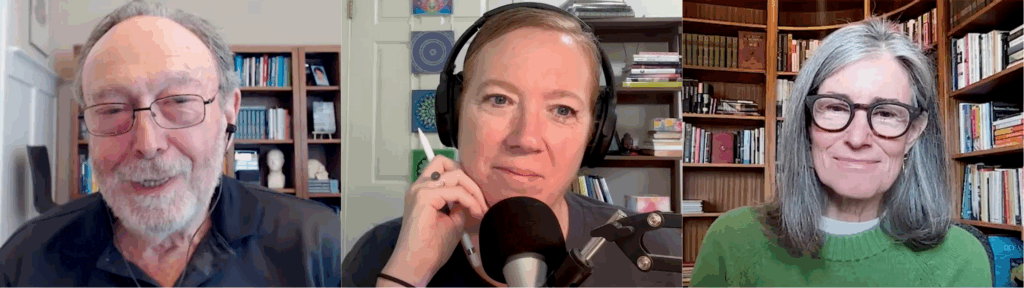
In this episode of Therapy Chat, I spoke with Dr. Stephen Porges and Karen Onderko, authors of the new book Safe and Sound: A Polyvagal Approach for Connection, Change, and Healing, to explore the revolutionary Safe and Sound Protocol (SSP) and how it can help your body find signals of safety, fostering connection, change, and profound healing.
Key Takeaways from Our Conversation:
Dysregulation is contagious, but so is regulation: When one person in a system becomes more regulated, it can have a calming, ripple effect on those around them. This highlights the profound impact of individual nervous system regulation on relationships and collective well-being.
The body holds the key: Our nervous system is constantly seeking signals of safety. When it perceives threat, even subtle ones, our body can become physiologically dysregulated, leading to defensive behaviors and hypersensitivities that traditional talk therapy often can’t reach. The SSP works by directly signaling the vagus nerve to promote a state of safety.
SSP is a “neural exercise”: Unlike a passive treatment, the SSP is designed to challenge your nervous system in a way that helps it become more flexible and fluid in shifting between states of defense and safety. It’s about training your body to be better able to find balance and self-regulate.
Healing is relational and titrated: While the SSP uses filtered music to impact the nervous system, it’s not a standalone “magic bullet.” It’s most effective when used within a therapeutic relationship, especially for those with complex trauma. The guidance of a skilled therapist is crucial for titrating the experience and helping clients integrate the shifts their body experiences.
Beyond behavior: addressing the bio-behavioral state: Instead of solely focusing on behavioral changes, SSP aims to shift the underlying bio-behavioral state that causes dysregulation. By addressing the nervous system directly, it allows individuals to feel better and become more receptive to the world, often leading to natural resolution of challenging behaviors.
Interested in getting trained in SSP – and wanting to ensure you deliver SSP in a trauma sensitive manner?
I’ve partnered with Unyte to offer a special discount on SSP training. Save $100 on training and receive a FREE trauma toolkit when you sign up for training at this link.
Other SSP Conversations:
I’ve talked about my experience more in depth in some other interviews. I interviewed my teacher, Paula Scatoloni two separate times and in both conversations we talked about SSP. And I’ve been on Paula’s podcast where I spoke in more depth about the relational spiritual aspects of what’s changed in me since doing SSP as a participant.
Safe & Sound Protocol (SSP) – The Practitioners Role | Paula Scatoloni
What Is Sound Healing with Psychoacoustics? Paula Scatoloni Explains
The Power of Sound and Community with Laura Reagan, LSCW-C
We’ve got more great content about trauma therapy for you!
Subscribe to Therapy Chat Podcast on YouTube to get each episode as soon as they are published!
Subscribe to Therapy Chat on Apple Podcasts! If you love Therapy Chat, leave a rating and review here!
Sign up for my email list to get news and updates about Therapy Chat and Trauma Therapist Network.
If you’re a trauma therapist, get discounts on trainings, special offers and learn about the Trauma Therapist Network membership community here.
Find my list of most frequently recommended resources for learning about trauma here.
Looking for holistic, somatically oriented trauma focused therapy in Maryland? My practice is accepting new clients virtually and in person. Visit our website here.
Full Podcast Transcript
Laura Reagan, LCSW-C She/her
All right, hi, welcome back to Therapy Chat. I’m your host, Laura Reagan, and with me today are Karen Onderko and Dr. Stephen Porges, authors of the new book, Safe and Sound, A Polyvagal Approach for Connection, Change, and Healing. I’m so grateful to both of you for being here today. Thank you so much.
Stephen W Porges
Thank you Laura, thank you for inviting us.
Laura Reagan, LCSW-C She/her
Yeah, you’re welcome. So I’m really excited to talk to you about SSP and this book. The protocol is something that’s super valuable and a lot of people are talking about it and I hope to dig into why you wrote this book, who SSP is for, how it can benefit each of us in the world and let’s just.
Let’s start off though by if both of you would just take a moment and tell a little bit about who you are just for context for the listeners.
Stephen W Porges
Go ahead, Karen.
Karen Onderko
Well, I’m Karen Onderko and I’ve been in this world of nervous system, nervous system regulation and SSP for almost a decade. And prior to that, I worked in a research lab at the University of Colorado. And that was a big shift in my career because before that set for 17 years, I was in the world of finance in New York City.
Laura Reagan, LCSW-C She/her
Lovely.
Stephen W Porges
And I’m Stephen Porches and I’ve been working on these ideas since I would say 1970, maybe the late 60s. So it’s a long period of time. And the transition for me was how do you take ideas and bring them into practice? And that’s as every academic has attempted to do, one of the greatest or most frustrating things to do. You have a vision, but now you need to be able to translate that vision into a practical reality.
And that actually leads us to the story of not the intervention, but really the application of the intervention and the accessibility of it, because it was in my laboratory and I didn’t know what to do next. You know, I was getting remarkable effects, but we first have to give you a little background, because if you have a crying baby, how do you calm the baby? Well, you use a prosodic voice, meaning the voice is melodic. If you have a kitten or a cat or let’s even say a rescue dog. How do you approach your pets with a voice with intonation? And in fact, we’ve done a study where mothers are required to calm their babies. And the question is whether the baby calms down or not. And it’s virtually totally dependent upon the intonation of their voice. So if the voice is more melodic, the heart rate slows up and their distressful behaviors disappear. So wired into our nervous system,
is literally a seeking system that is looking for signals of safety. And it’s part evolved with mammals, because mammals, unlike their vertebrate ancestors, which came before, are a social species. And so everything is about signaling the other that you’re safe to come close to. And for social mammals like cats, dogs, horses, humans, intonation of voice is powerful.
And facial expression is important, but intonation of voice doesn’t even require looking at the individual. And we all know that some people we like to listen to and some people we may agree with them, what they’re saying, but the intonation makes them less than acceptable for us. So let’s move it forward. To develop this intervention in the laboratory, I called it the Listening Project Protocol, quite an agnostic type of title.
Stephen W Porges
And what I wanted to do was develop a stealth intervention that the nervous system could not refuse, couldn’t reject, couldn’t turn off, had to respond to. And where the nervous system would move into a more accessible one. And in polyvegal terms, we mean turning on the social engagement system, down regulating your defenses or sympathetic fight flight. And this was really the model. The model was intonation of voice. And so we created the
basically using vocal music initially with computer algorithms that filtered so that the intonation of vocalizations became amplified and virtually all the other frequencies became minimized. And that was what we tested in the laboratory and it worked extremely well with children who had auditory hypersensitivities. It was working really great with autistic children and for some of them.
they no longer fit the diagnosis afterwards because their hypersensitivities were down. It didn’t change the way they literally related to the world in general, but it changed their reactivity to the world. And so they became less of a burden. And it was extraordinarily interesting to watch an autistic kid who went through the protocol, which was five one hours, turn and look towards me like this is what one individual did. After five hours.
I walk into the room where he was getting the intervention. He turns towards me, puts out his arm, and says, good morning, Dr. Porteous, with face-to-face eye contact. And this is something you can’t achieve with behavioral modification. anyway, that was the story of the intervention. And then I didn’t know what to do with it. And in walks into my house, Karen and Randall Redfield from the Integrated Listening Systems. And they came to visit me when we were in North Carolina.
to discuss literally a podcast. And they told me what they were doing. said, well, you I have this intervention. You might find it of interest. And that’s how it worked. And what I would say the most fortuitous moment was the fact that Karen got interested in it and got excited. And she became the steward of polyvagal theory and the Safe and Sound Protocol within the Unite organization. And she created this wonderful relationship with the providers.
And the book is really the product of Karen’s relationship with the providers. Because we would get emails. She got emails, and I would get emails about people who had experiences. And I would contact her and say, save this, because we’ll write a book sometime. And so the idea was to give voice to those who had experienced a transformation from something that on
Laura Reagan, LCSW-C She/her
Mmm.
Stephen W Porges
hypothetically or theoretically is really simple. It’s just saying, can my body feel safe enough so that I can engage another? And the stories were just profound and interesting. So from my perspective, the goal is not the book as a manual for SSP, but the book as providing a portal for the users, for the clients, and the providers to have a voice of what they observed.
Karen Onderko
I can’t tell you those early months when we were meeting after we had decided to collaborate on the listening project protocol, which then became the safe and sound protocol. And we had weekly meetings where we would talk about what the next steps were, what we were focusing on. And we started every meeting with a story. That was the first thing we always talked about was what we were hearing from users because we were learning so much from them. And also they were
Kind of astonishing, you know, the idea that cues of safety in the form of frequencies of music could allow someone to feel safer and down regulate their defensiveness was just playing out in real time. And in these stories, there was one young girl, she was about nine and her father did the SSP with her. she said, he asked her how she felt afterwards. And she said,
She actually wasn’t a native English speaker, but this is how it translated. She said, my stomach has a smile with eyes that blink very happy. And I think she did this with eyes that blink very happy. So just to hear the stories of the visceral impact and then the changes that it made and the ways that it affected themselves, their relationships and their families and in their schools.
Laura Reagan, LCSW-C She/her
Yeah.
Karen Onderko
were just astounding. And yes, we did keep those stories and they are filtered throughout the book.
Laura Reagan, LCSW-C She/her
That’s amazing. know, the visceral, literally visceral, know, stomach has a smile with blinking eyes. I’m curious, made you, what were you, what made you think this was needed? Like, how did it start?
Stephen W Porges
Are you a parent? Or a teacher? Basically, what we see is individuals who become physiologically dysregulated, biobehaviorally dysregulated, and they don’t respond to simple words like calm down, have something to eat, sit down, or do your homework. It just doesn’t work because their body is in a state
Laura Reagan, LCSW-C She/her
Yeah.
Karen Onderko
Thank
Stephen W Porges
that’s supporting both defensive behaviors, but also hypersensitivities. So their threshold to react is lower when they are in a state of, let’s say, mobilization or threat. So the portal of treatment has to more efficiently hit the viscera, hit the body, hit the autonomic nervous system, as opposed to the intelligent, conscious agency of our cortex. So in a sense,
I used to say that if the cortex ran the show, no one would be depressed. No one would be anxious. You know, they would just command themselves not to be anxious. And in a sense, many people who like go through grieving or really severe situations are told by friends, spouses, get over it. It’s like, you know, you’re a grown person. Take it. You know what you need to do.
Laura Reagan, LCSW-C She/her
yeah.
Stephen W Porges
And so we have a culture that is continually giving us signals to suppress the feedback that our gut, our body is giving us. So the development of SSP was to really signal the system that regulates our bodily feelings and to give it signals of safety because if it has signals of safety, it’s going to automatically dampen the signals of defense or reactions of defense.
Laura Reagan, LCSW-C She/her
Yeah, it’s amazing. I mean, I have to say as someone who’s experienced it myself in adulthood, I mean, I’m 53.
you don’t know well for myself, and this is maybe something to discuss, like I didn’t know how I was responding defensively. thought certain things were just my personality. I tell people I thought I was really nice, but I’m really not as nice as I thought I was because I actually have my own opinions and what I like and don’t like. And instead of being like,
Sure, whatever you want’s fine with me or, well, I guess I can’t say no to that. You know, it just, it’s like, yes, you know, I like this, I don’t like that.
Stephen W Porges
So, Laura, what you’re really describing is really everyone. And what everyone does is whatever they do, they have a narrative of why they’ve done it. And that makes them a good person. So they create the role of being heroic, even though they may be reactive, they may be evaluative. But remember, they’re doing that for a good reason. So it’s like, you know, it’s for your own good. I’m acting this way towards you. So we are a very evolved creative species.
Laura Reagan, LCSW-C She/her
Yes.
Laura Reagan, LCSW-C She/her
Right.
Stephen W Porges
But what we do is we take those bodily feelings and we retell the story. What are those bodily feelings doing? Well, they get into our body or they are our body and we broadcast them and they’re broadcasting signals of threat, of uncertainty, of fear, and they’re impacting on others around us, not just our children and our friends, our spouses, but even our pets. So because our voice, our motor movements,
are really broadcasting those physiological states. So Safe and Sound Protocol is all about the broadcasting of physiological signals and then reversing it and saying, what happens when you listen to signals of safety? What does your body do? And what happens, and this is where, especially in the world of trauma, it becomes really interesting, potentially exciting, but also potentially, I’m going to say,
Let’s use the word interesting because what it does is it sends a signal that the body cannot refuse to interpret as being safe. And when the body gets a signal of safety, what does it do? It becomes accessible. If you carry trauma, that bodily feeling of accessibility carries on a different meaning. And that meaning is vulnerability. So with trauma, SSP found a different…
Laura Reagan, LCSW-C She/her
Yeah
Stephen W Porges
…home than it did in, let’s say, pediatrics and autism and hypersensitivities. Because with them, with those who are hypersensitive, without severe trauma histories, they merely could process the signals of safety, and suddenly the hypersensitivities miraculously change, surprisingly, because of the dependence of hypersensitivities on physiological states.
Stephen W Porges
And actually, I have a lot of data on that now. so the issue is we’re not hypersensitive independent of our visceral state. So it’s like we’re broadcasting it, of course. If I’m like this, my body is ready to defend. But what happens in the world of trauma? The body can’t help but respond. So it becomes more, let’s say, open, more accessible. And now there’s an interoception. Those bodily feelings are no longer a gut that’s smiling. It’s a gut that says,
I could be injured because the last time I was in that state and I trusted I was hurt. And so the cortex is interpreting the interoception, the feedback. And suddenly the person reacts, says, can’t listen to this anymore. And the trauma therapists were smart. And I would say I wasn’t that smart because when I heard some of these reactions, I basically like following simple rules and the rule is do no harm. And if someone is reacting adversely to something that I created,
I don’t want any part of it. I just don’t want it used in that population. The trauma therapist said to me, says, this is powerful and we know how to harness it. And they did it through titration, slow processing of, a sense, allowing the body, the nervous system to understand those feelings before they get interpreted as being potentially instead of vulnerability. They say,
I’m now describing what it’s feeling, and that’s interesting. I’m going to do a little segue for a moment, because I was working with a 42-year-old adult. This is in the 90s. And he was an autistic adult whose mother said he’s the most selfish, nice person I’ve ever met. I said, what do you mean by that? She says, all he does is everything about me is about him. He’s concerned, will I be alive? Will I be this to take care of him? So they came to my lab.
And after the fifth day, he’s the one who reached out and said, morning, Dr. Portis. But I then asked him, I said, how do you feel,
Stephen W Porges
And there’s dead silence because he’s seeking, he’s very bright. He’s seeking a word that describes those bodily feelings that he was so unfamiliar with. And then slowly with his Alabama accent, he says, relax. Because he couldn’t find the word. He couldn’t find the word. He had no experience with the word. And so this is the beautiful thing is through interoception.
Laura Reagan, LCSW-C She/her
Thank
Laura Reagan, LCSW-C She/her
Hmm.
Stephen W Porges
the experience. And this is what the clinicians work with as the body starts to talk and that language is now being interpreted.
Laura Reagan, LCSW-C She/her
Oof.
Karen Onderko
Yeah, that was a lot. But what I picked up from from that discussion was that the titration of SSP music is so important in particular for adults who have complex trauma or any kinds of trauma. Because the signals of the cues of safety do actually just directly affect the nervous system without any intention or effort or
thoughts on the listener’s part and then they react. And paradoxically, having a sort of a reaction or negative reaction early on is a great signal that the SSP is going to be quite helpful for that person, but that the therapist is gonna need to figure out the titration so that they have enough listening that they don’t get to that kind of reactive point. And…
That was the learning during those early years when the world of trauma kind of embraced the SSP. I wanted to say one more thing about that. Well, anyways, simply that children don’t seem to need the same levels of titration as adults do. This is what I did want to say.
Not only is the titration the amount of listening to the SSP that’s important to focus on, but the therapist themselves have to be in a connected ventral vagal state in order to deliver it. So the SSP is sending cues of safety and when the provider’s cues are in line with the cues of safety from the music, things go very well.
And for the therapist to be attuned and present with their client is so key because first of all, that’s how they’ll notice if it’s getting shaky at all. But also their cues of safety that they’re giving to the client are themselves allowing the client to be curious and receptive to what’s happening.
Laura Reagan, LCSW-C She/her
Yeah, thank you. know, you know, I think that one of the things that I would like to kind of put out there with this conversation is sometimes people may get the idea that SSP is like one of those things where, you know, you could go to like a wellness spa and just hook yourself up to it and do the thing and then, you know,
that’s magical effect and good to go. But it’s really a relational experience. I’ve talked to some people who’ve done it where they just, they listen completely on their own. know, the provider set it up for them and they just listen on their own. they,
they might say, yeah, it was cool, yeah, it was helpful. And I’ll say, did you experience this? Did you experience that? Did you experience this? And they’re like, no. So for me, it was like a super profound experience. And the second time I did it, it was super profound again. Although the first time it was like a night and day change. And then the second time it was like deepening that effect.
Stephen W Porges
Yeah.
Hmm.
Laura Reagan, LCSW-C She/her
So any thoughts on that, the part about like it being relational and.
Stephen W Porges
Yeah, let’s start by saying that it’s not a standalone therapy. Now, when I developed it, I thought it might be for hypersensitivities and where there is sense a child feels safe enough to go into a clinic with another adult. But when we start moving into the adults, it started to be a totally different story. And then I start to realize that the adult is coming into the therapy without a protective
another adult. The person is now having to drive there, go there, walk off a flight of steps, sit down in the waiting room, go in and then be one on one with another adult. So there’s no one literally taking care of the client in the way that we like to think. If I give up my defenses, is there someone here to take care of me? And what you’re describing is that the adjunctive therapy of the Safe and Sound Protocol works best.
Laura Reagan, LCSW-C She/her
Hmm.
Laura Reagan, LCSW-C She/her
Mm-hmm.
Stephen W Porges
when the physical, the physiology of the client feels safe enough to give up defenses. In a sense, then is going on this journey of shifting into these different states. But if they don’t feel safe enough, the body’s going to react to it. And it’s either not going to go anywhere in terms of the treatment. It’s just going to be blah. Or they’ll be more hyperreactive to it. And when I developed it, this is really the issue was I thought it was
stealth that you we just could slide in. And I didn’t realize that I was not the best person to test it. You know, it’s like, because I kept on wanting to get more change, I want more power in it. And I would say this is just so trivial. It’s just not enough until we tried it on some severely autistic individuals. And then of course, when the trauma world start using it. And the issue is
If your body is already retuned into a state of more fight flight, then it can be extraordinarily profound because the body is not necessarily welcoming to turn those defenses off. And what this is doing is it’s bypassing the welcoming. It’s just doing it. And then you basically get the response. And now you’re in a therapeutic with that relationship with the therapist. How do you navigate? How do you use that information to inform?
the client about the journey they’re on.
Laura Reagan, LCSW-C She/her
Yeah.
Karen Onderko
As an example, if I can just tack onto that of SSP being a pairing really well with other modalities and, maybe even being an accelerant of other, other modalities, the Meadows and addiction rehab facility, uses SSP in their, in their, in practice that they offer. And they always start with SSP. That’s the first modality that they use because they know that if they can help the bodies to, client’s bodies to
calm down and be open that everything that follows will go more smoothly and more easily. And I would say that most people delivering SSP, most SSP providers do use SSP within the context of their discipline or the other modalities that they use. So.
Stephen W Porges
That includes even in the pediatric world like OT and play therapy.
Laura Reagan, LCSW-C She/her
Yeah, and that is what I’ve begun to gather that a lot of people use it with somatic experiencing. I don’t know, maybe EMDR.
Karen Onderko
SC Somatic Experiencing.
Stephen W Porges
Yeah, it actually fits very well with any, actually it fits well with all therapies because they’re all about, in the world of trauma, I like to simplify what is trauma therapy. It’s about a journey of becoming re-embodied. What does that mean? It means you start becoming more aware of the signals that your body is sending. Because what does trauma do? Trauma disrupts the feedback loops, the interoceptions, the feeling and numbness.
becomes one of the features, flat affect and numbness. So if we step back and say, what is that telling me? It’s telling me that they’re actively, to survive, the body has shifted state, down-regulated visceral bodily feedback, and optimized detection of threat. So there you have hypersensitivities. You have flat affect. And then you also have other features like selective eating, because
That’s also violation of expectancy is threat. And then in the world of trauma, you see the, I would say, complementary symptoms like irritable bowel problems or gut problems. And what that is telling you that the ventral vagus, the social engagement system, went for a vacation and now the body is vulnerable to its sympathetic defenses or its dorsal vagal defenses. So what you have is in a sense,
Laura Reagan, LCSW-C She/her
Yes, so much.
Stephen W Porges
with the gut either constriction, which is constipation, or total evacuation, which is diarrhea. And so you have these oscillatory features because the body is trying to regulate digestion and elimination, but not in a more homeostatic way.
Laura Reagan, LCSW-C She/her
So glad you said that about the gut because I actually had wanted to go back to that when we were talking about interoception and then you mentioned the example of the child with the happy tummy and gut issues. I feel like they’re so prevalent in our culture and we have medicines and you know.
Stephen W Porges
Yeah, so jumping in on this, like saying it’s one of the biggest, let’s say, markers that we can see in our society, that the society is a traumatized or chronically stressed. It doesn’t matter what word we’re using, but it means that the homeostatic processes have been disrupted. I don’t like using the word stress and trauma in itself is only defined by the individual’s response. So I’d like to move it back to the individual and say,
disruption of homeostasis is what we need to look at. And when you say the gut’s not working right, you’re saying homeostatically, my most primary metabolic system is dysregulated. And when does it get dysregulated? It gets dysregulated when the priorities of survival shift from, in sense, serving the body versus trying to find safety in a dangerous world.
Laura Reagan, LCSW-C She/her
Hmm. Yeah, and I think it might be helpful if you would explain how you’re defining homeostasis to just for the listener.
Stephen W Porges
Okay, we’ll keep this. Okay, homeostasis is our body is, okay, so much of what we’re taught is that we have certain systems, we take certain measurements, and if they’re out of balance, we do something to increase one limb or reduce it. So we work for a balance. We aren’t sophisticated in our culture to think about the dynamic internal regulation through our autonomic nervous system.
of our physiological systems. And what they do is they have rhythms. So you have a digestive rhythm and you can actually measure that in your gut and it’s very slow rhythms. And you have heart rate variability, which people measure. They don’t know what it really means, but they measure it and they say, if it’s high, it’s good. And that’s also rhythms that are being reflected in the heart rate, but they tend to be breathing rhythms. It can be vascular rhythms.
So the bodily head, the body has numerous rhythms and those rhythms are telling us, telling us if the feedback systems between the organ and the brainstem are working. Because when you see these rhythms in the gut, in the heart, the rhythms are coming from the brain down, but they’re responding to what those organs are sending up to the brain. And so if we take a real simple model and say,
Depression of rhythms is stress, is disruption of homeostasis, is what we have in virtually, it becomes a common core among many disorders, both physical and mental, that’s disruption of those homeostatic processes. The body doesn’t seem to discriminate, or let’s say the nervous system, between mental threat and physical threat, meaning mental illness and physical illness. Threat is threat. A pathogen is threat, like
COVID, now we have things like long COVID. And in long COVID, during COVID, the pathogen was real. And then the nervous system and the body fought the pathogen, won the war. But along the line, the winning of the war was never, never informed the system that defends. And so the nervous system became locked into a state of threat. And that’s long COVID. But that’s also chronic pain.
Stephen W Porges
So chronic pain is when the source of injury has healed, but you’re still feeling pain. The pain is real. And this is where it gets into a really complicated space within medicine. If they can’t find the pathophysiology linked to the symptom cluster, it then becomes viewed as if it’s the patient’s fault. The patient is maligning. And the issue on this is a misunderstanding. The patient is suffering.
and suffering through a neural regulatory dysfunction, not through a pathophysiology. And so signaling the nervous system is the way to get it moving back. And of course, we’re seeing a lot of research and even tools like vagal nerve stimulators, which are really stimulating that sensory feedback to say that things are OK and they have very positive effects on the body.
So with the vagus nerve stimulation, it’s basically viewed as hacking the body. And the safe and sound protocol is using an auditory signal that also impacts on the brainstem to basically say, you’re safe. Go back to regulating your organs.
Laura Reagan, LCSW-C She/her
Thank you. Thank you for that explanation. one of the things that’s in the book is the, if I hope I get this right, that the vagus nerve stimulators are like permanently in the body and SSP is something that can be, you know, titrated.
Stephen W Porges
Yeah, Yeah, the issue is the simple bit. SSP is a neural exercise. So it’s like any form of exercise. You challenge the system, you relax the challenge, you increase the challenge. So there’s a program of challenging the system until the system becomes more, let’s say, fluid, more flexible. Vagal nerve stimulators originally were implanted.
But now they’re using the auricular afferents of the vagus in the ear. And there some that are really using electrical stimulation on the neck. it looks like an electric razor, and you put it against the neck. The part of both those models is that they’re not truly neural exercises. I view them as more on the prosthesis side. But I think the protocols that they use
Laura Reagan, LCSW-C She/her
Okay.
Stephen W Porges
will determine whether they’re neural exercises or prosthesis. Meaning if it has a program of stimulation and then challenge and then stimulation, where the nervous system becomes more accustomed to the feedback loop working.
Laura Reagan, LCSW-C She/her
Thank you for that explanation. think people want to understand these differences, so I really appreciate that you’re taking the time to explain that. Anything you want to say, Karen?
Karen Onderko
yeah, I would just, put it in, another, in other words to sort of have it come out, come out of that from another angle is that what’s happening with SSP with the music as the music filtration shifts throughout the listening is that you’re engaging and disengaging the vagal break. Well, your nervous system is engaging and disengaging the vagal break. And that practice of shifting through your states actually improves the capacity to do that. So.
It allows you to be better able to find balance in your nervous system and flexibility in your nervous system because you’ve been giving it this neural exercise.
Laura Reagan, LCSW-C She/her
Thank you, yes, that helps too. So let’s talk about what you’ve found. I know you said the first third of the book is like the research, some of the research on SSP. Can you talk about what the findings have been? Like how has, what change does it…
You know, you’ve talked about how it can be helpful with autism and how it can be helpful with trauma. Whatever your studies shown.
Karen Onderko
Yeah, I’ll just start with the list and you can expand, Steve. So in peer-reviewed publications and studies, it’s been, FSP has been shown to reduce auditory hypersensitivities and really sensory sensitivities in general to improve auditory processing. That is to understand, well, to listen better and understand the meaning behind words.
It can reduce symptoms. It’s been proven to reduce symptoms of anxiety and depression, to improve emotional control, to calm the nervous system and make someone more accessible to engagement, promoting social engagement.
Laura Reagan, LCSW-C She/her
Yeah, that’s a lot.
Laura Reagan, LCSW-C She/her
Anything you want to add, Steve?
Stephen W Porges
Well, would add to what the laboratory studies have been really quite remarkable. I really find the hypersensitivity domain really interesting because it’s affecting not merely auditory, but also visual. And the paradoxical one where auditory hypersensitivity is reduced, but auditory hyposensitivity to voice is enhanced. So you understand human speech better.
And so this has been a paradox in the treatment of autism because individuals who don’t follow verbal commands have been assumed they can’t hear. And yet they have auditory hypersensitivities. But those hypersensitivities are really masking the ability to extract human voice. It’s a different process. It’s a different structuring of neural regulation of middle ear muscles so that when we dampen the sound of low frequency predator sounds,
the things that bother us, the rumble, then we can start pulling out voice. So that’s important. The other part I wanted to bring up was what I really have a smile on my face because I really want the tool used in clinical practice as an adjunctive tool. And that’s where Unite on its web page even has its own studies of case studies on dashboards with several hundred.
And what it does is it basically reduces symptoms of anxiety, depression, even symptoms of PTSD. And on the pediatric scales, it also increases, I would say, more organized behavior and emotional regulation. But beyond that, what’s interesting is when they use it within their protocols of the treatment, on these scales, the child or the adult is moving from a rating of concern
to a normative level, and that to me was really important. Not merely does it reduce these symptoms, but now with these survey tools, it moves them into the level of normal behavior.
Laura Reagan, LCSW-C She/her
Yeah, so I feel like
I’m curious, I don’t know how to ask this, so this might just not end up being a great question, I’m curious about that, like the idea that…
You know.
people who, autistic people are not, know, there’s nothing broken with them, they’re not flawed, but being autistic in a world that’s very over-stimulating can be excruciatingly difficult. so you mentioned that word masking, it made me think of it, that is it that it takes, it
lifts the way that the system is reacting to the overstimulation of the world. It’s not going to take away the person being autistic.
Stephen W Porges
Yeah, I’d like let’s deal with my own biases. And my biases can reduce the burden of suffering for humanity. And when I look at individuals who carry a diagnosis of autism, I have one big question comes to my mind. What would their lives be if they weren’t hypersensitive? Not what would their lives be if they weren’t autistic, but what would they be without being hypersensitive?
Laura Reagan, LCSW-C She/her
Yeah
Stephen W Porges
The unique way of thinking, I think this is remarkable and wonderful. And I come being an academic where many of my colleagues could be diagnosed on spectrum as part of that world. So you start understanding that creativity and focus on object is a gift for some people. But the issue is that the problem of compromising life is the hypersensitivity, is the inability to be in social settings.
And I see this as pain that does not need to be experienced. And that was really what was the motivation behind the Safe and Sound Protocol. And I will tell you what I’m working on now. And this is a new product, and it’s with a vision. I want you to take this visual image that if you see autistic individuals, you basically say, that’s who they are. Now, I want you to visualize that same child in a rock concert…
Laura Reagan, LCSW-C She/her
You
Stephen W Porges
…with a smile on their face sitting like this.
So I am building a type of filter that enables autistic individuals or neurodivergent, let’s get in the real broad world, to experience the acoustic environment like a typical. And then I’m also using the same model to literally remaster or change the acoustic features of recorded music.
Laura Reagan, LCSW-C She/her
Hmm.
Stephen W Porges
So to me, actually, this is how I dealt with the post-election. This is how I went into a level of creativity and developed these algorithms and actually submitted a patent because I got myself really focused on this. And it made me feel good because I could see what was missing. It’s not the notion that you have to block out or, and I still remember in the early 2000s or late 1990s, going to schools with autism…
Laura Reagan, LCSW-C She/her
Yeah.
Stephen W Porges
..for autistic kids and they would be wearing a microphone that looked like the kind of a speaker and headset and it was just an amplifier amplifying the sounds because they were being treated as if they had a hearing deficit as opposed to auditory or listening deficit which is different and because the speech and hearing sciences didn’t have a model for this differentiation but Polyvagal Theory did, and that’s where SSP came in.
It’s basically saying this is part of a social engagement system. Those middle ear muscles that dampen low frequency sounds, but when they don’t dampen those, they block out human voice function more like our autonomic nervous system so that when we’re under a state of threat, we hear low frequency predator sounds. And when we’re in state of safety, we hear human voice. So it all makes sense within a model of adaptive adjustment to survive.
Laura Reagan, LCSW-C She/her
Well, I appreciate what you just said, and I’m thinking that it’s good for people to hear too – that it doesn’t take away our ability to respond to threat when we’re in actual unsafe situations.
Stephen W Porges
Yeah. Yeah. It gives us the flexibility. But remember, responding to unsafe is great. But when we move into a safe environment, does that hypervigilance drop down? And this is what we talk about in the world of trauma, in that as the system got locked into a state of defense, and now being in public places can be extremely uncomfortable.
Laura Reagan, LCSW-C She/her
Right.
Laura Reagan, LCSW-C She/her
All right, this is a little specific. Karen, go ahead.
Karen Onderko
I just want to say two responses to that, Steve. And first of all, what you just have written the patent for and what we’ve just been talking about this idea of like an in the moment state shifter is your first 100 days. And congratulations and thank you, something terrific. And also, I just want to reiterate this idea. think it’s important. want to make sure it doesn’t get lost that the SSP as Steve conceived of it was at the time when he conceived of it, therapies for people on the spectrum were really focused on behavior – for many therapies focused on behavior. And instead of focusing on the behavior, Steve looked to the bio behavioral state that was causing the behavior and the SSP or LPP at the time.
Its goal was to help shift that bio-behavioral state so the individual just felt better and more receptive to the world, but also the behaviors then naturally would resolve. So I wanted to make sure we amplified that point.
Stephen W Porges
I also want to thank you, Karen. It’s bi-directional. So when the child’s behavior changed, what I noticed immediately was that the family’s behavior changed, especially the fathers in the autistic world. Fathers were saying, “I now have a real son.” I mean, those are the terms they were using because they couldn’t connect. And now they were connecting and they were really excited to connect.
Laura Reagan, LCSW-C She/her
Mm.
Karen Onderko
I often say that dysregulation is highly contagious, but so is regulation. We saw that early on actually, the Rebecca school, a school for children and adults, I think up to 21 on the autism spectrum. And they were sampling the SSP for their school population. What they found was that, and they were doing it just individual student by student.
Stephen W Porges
Yes.
Karen Onderko
And what they found is that when one student in a classroom went through the SSP and became more regulated, that classroom itself would calm down. Their regulation was contagious within the whole classroom. So we just keep seeing this again and again.
Laura Reagan, LCSW-C She/her
That’s really powerful. It reminds me of someone recently was saying that you have to attune to the most sensitive nervous system in the room when you’re training. But if the most sensitive nervous system in the room is big dysregulated, then everyone else is gonna get dysregulated. That makes sense.
While I was gonna ask just, I don’t know if you can answer this, so again, if not, like, we’ll just scrap it, but for an adult who’s…their early, say first three years, they didn’t have a strong enough attachment bond with their primary caregiver. And now as an adult, they are in relationships, they don’t identify as autistic, but they feel like revulsion or recoil when people behave in a nurturing way toward them. Would that be something that might be helped through SSP?
Stephen W Porges
Hmm.
Laura Reagan, LCSW-C She/her
Or is that just like a way that some nervous systems are?
Stephen W Porges
Well, no, it’s not the way nervous systems are. It’s what has happened to a nervous system. It’s actually a document. You’re documenting what I mentioned earlier, that during those three years, the nervous system was becoming accessible, but it was really becoming vulnerable because those who were supposed to connect and take care of weren’t, in a sense, doing their job. So the issue is not that there’s anything wrong with the nervous system.
Laura Reagan, LCSW-C She/her
Right.
Stephen W Porges
…not that it’s now locked in and can’t get out, is that we now see the trajectory of an adaptive system that is basically birthed into an environment that wasn’t safe and adjusted. So part of the therapeutic model is literally you start praising that individual’s nervous system for you honor it. Because what happens is that in most therapeutic models, the individual is feeling very sad and guilty about their nervous system, they’re embarrassed by it. They want, it’s failed them. And instead, as you start, in a sense, praising what it’s done in terms of its adaptive one to keep the individual alive and safe, you start getting a portal into moving that state. So the defense of staying in there starts to dissipate and slowly opens up. And in a sense, the models are always the same.
Laura Reagan, LCSW-C She/her
Yeah.
Stephen W Porges
If you get a rescue dog, what do do with the rescue dog? Do you run and grab it and hug it? No, you expect it to be tentative and slowly. So in a sense, the nervous system has to be trained to accept the other in proximity. In a sense, accessibility is the word. The nervous system is becoming trained to become accessible. And that’s where SSP helps.
Laura Reagan, LCSW-C She/her
You have to work slowly, yeah.
Stephen W Porges
But relationships help, support, presence support. And even with older people that you may be working with for these histories, top-down narrative, psychoeducation is powerful. Once they start to understand their own trajectory, they start creating a different narrative. The beauty of the world of trauma, from what I learned from it, is that it doesn’t matter how disruptive the lives have been. Whether there’s never been an experience of truly being safe enough in the arms of another, there’s still a vision of that occurring. And I found that really kind of a remarkable feature what it is to be a human. That is, even if we don’t have this experience, we have a vision of what this experience could be like.
Laura Reagan, LCSW-C She/her
Hmm. It reminds me of a, interviewed Peter Levine and he said, it’s never too late to heal your inner child. I was like, yeah. Healing is always possible. So I’m really grateful for what you both are doing to contribute to helping and needless suffering in the world and, you know, bring.
kindness, dare I say. I know that’s weird, but talking about kindness, but I really appreciate you both.
Stephen W Porges
Well, thank you, Laura. Basically, what this journey has taught me and actually the journey of Polyvagal Theory, of Safe and Sound Protocol is that we have embodied in our own nervous system, toolkits to be this benevolent, generous, connected species. And it’s only through external features of how we are raised, the culture that we’re in, the demands placed on us, that we down regulate this wonderful sense of what it is to be a human.
Laura Reagan, LCSW-C She/her
Well, thank you both so much for spending some time here with me on Therapy Chat today. I can’t wait to share this and your book with everyone.
Where can people learn more? Do you want to give like your website or the Unyte website? What’s the best way for people who want to dig deeper to find the book and all this good stuff y’all are doing?
Karen Onderko
First of all, the book is available at the publisher Sounds True at their website soundstrue.com. There’s also a bonus page for the book on that same website soundstrue.com. What is it? Safe hyphen and hyphen sound. And I think that will take you to that. I’ll make sure I send you the correct link. If for more information about SSP itself, Unyte is the
Laura Reagan, LCSW-C She/her
Okay, I’ll link to that.
Karen Onderko
a licensure of SSP and they have a terrific website and there’s a lot you can learn just by going there. And then the Polyvagal Institute is another great place to learn more such rich resources on polyvagal theory. And that’s polyvagalinstitute.org.
Laura Reagan, LCSW-C She/her
Beautiful. link to all of those in the show notes and anyone who’s listening can save, anyone who wants to be a certified SSP provider can save on the training with the link in the show notes too. So thank you both again so much for being here today on Therapy Chat.
Karen Onderko
Nice.
Karen Onderko
Thank you, Laura.
Stephen W Porges
Thank you.